Your dog is 10. She still finds her ball, still meets you at the door, still takes the stairs. Her eyes look fine to you.
That is usually how it goes right up until it doesn’t.
August is National Eye Exam Month, and it is a good moment to think about your dog’s eyes the way you think about your own. Not because something is wrong, but because the changes that matter start quietly and build for years before they reach behavior.
Frequently Asked Questions
How do I know if there’s something wrong with my dog’s eyes?
Look for cloudiness, redness, squinting, pawing at the face, discharge, or a change in confidence moving around, especially in dim light. Because several senior eye conditions are painless early on, behavior often changes before anything looks wrong.
What can I expect during my dog’s eye exam?
Around 30 to 60 minutes in a dimmed room. History and questions first, then a pupil response check, then tear production and intraocular pressure readings, then a structured look through the cornea, iris, lens, and retina. The eye exam is painless.
Why should my dog see a veterinary ophthalmologist?
For anything needing specialist equipment or surgery: confirmed glaucoma, suspected retinal degeneration, a non-healing corneal ulcer, or a cataract surgery evaluation. Routine senior eye exams stay with your regular veterinarian.
Is a cloudy eye always a cataract?
No. Nuclear sclerosis produces a similar blue-grey haze and is normal aging that leaves vision largely intact. Only a dilated exam distinguishes nuclear sclerosis from a cataract reliably.
How can I help my dog preserve their vision?
Twice-yearly eye exams from age 7, prompt attention to any change you notice at home, sun exposure managed in summer, and daily antioxidant supplements aimed at the oxidative stress that drives lens clouding.
Do the drops and the chews do the same thing?
No. The drops deliver antioxidants into the fluid surrounding the lens. The chews supply nutrients the body uses to maintain its own antioxidant defenses. They address the same problem from outside and inside.
Why Age 7 Is the Number That Matters
A cross-sectional study of canine cataract led by David Williams at the University of Cambridge put a figure on the timing. The age at which 50% of dogs show some degree of lens opacity is 9.4 years. Every dog in the study over 13.5 years had some.
Read that as a range rather than a deadline. Plenty of dogs at 9 have clear lenses, and plenty of 12-year-olds see well enough to do everything they want to do. What the number says is that lens change is ordinary canine aging, it is common, and it is already underway in half of dogs by the time they hit double digits.
So the useful eye exam is the one you book before you have a reason to. Age 7 is the sensible baseline for senior dogs and senior pets, because it gives your veterinarian something to compare against later.
Cloudy Eyes: Nuclear Sclerosis and Cataracts
Two different things make a senior dog’s eyes look hazy, and they have very different consequences.
Nuclear sclerosis is normal aging. The lens keeps producing fibers throughout life, and with nowhere to shed the old ones, the center compresses and takes on a blue-grey haze. Vision stays largely intact. Most dogs over 8 have some nuclear sclerosis.
A cataract is opacity caused by damaged, clumped proteins inside the lens. Light scatters instead of passing through, and vision loss follows as the opacity spreads.
From across the room the two look similar. Distinguishing nuclear sclerosis from cataract takes a dilated look at the lens with proper magnification, which is one of the better arguments for booking the exam rather than watching and waiting.
What the Exam Actually Includes
Your regular veterinarian does this. There is no separate eye clinic to find and no referral needed unless something turns up that needs one. It is a request you make at a visit you were already booking.
“The vet looked at her eyes” during a routine checkup is a glance. A real ophthalmic exam is a defined sequence, usually 30 to 60 minutes, done with the room lights dimmed.
Your veterinarian starts with history: previous eye conditions, current medications, any change you have noticed at home. Then a check of how the pupils respond to light, followed by a structured look at each structure of the eye in turn, working front to back through the cornea, iris, lens, and retina.
The examination itself is painless. Most dogs sit through it with nothing more than a treat and a steady hand on the shoulder.
The Diagnostic Tests, and What Each One Finds
Ask your vet for these diagnostic tests by name. A general “can you check her eyes” gets you something different than a named request.
- Schirmer tear test. A small paper strip measures tear production over 60 seconds. It detects keratoconjunctivitis sicca, the dry eye condition that is common in older dogs, uncomfortable, and very treatable once named.
- Tonometry. A quick tap-style reading of intraocular pressure. Raised eye pressure is glaucoma, which damages the optic nerve fast and is far more manageable caught early.
- Fluorescein stain. A green dye that clings to damaged tissue on the cornea, revealing a corneal ulcer or scratch. Worth requesting if your dog has been squinting or pawing at her face.
- Ophthalmoscopy and fundic examination. Drops widen the pupil first. That dilation is what lets your veterinarian see the whole lens, including the outer edges where clouding usually starts, and then the retina and optic nerve behind it, checking for retinal degeneration, retinal detachment, and other changes invisible from the front.
Ophthalmoscopy is the workhorse here, and a dilated fundic examination is the part of the visit most likely to be skipped when nobody asks for it.
Two further diagnostic tests come up when something specific is suspected. Gonioscopy examines the drainage angle of the eye to assess glaucoma risk, and gonioscopy is the diagnostic test that tells you whether the unaffected eye is likely to follow. Electroretinography measures the electrical response of the rods and cones at the back of the eye, which is how retinal function gets confirmed before cataract surgery.
Common Eye Conditions in Senior Dogs
Beyond cataracts and glaucoma, the canine eye conditions a fundic examination and full workup look for in older dogs include:
- Dry eye (KCS), where tear production falls and the cornea suffers for it. Untreated dry eye is a common route to a corneal ulcer.
- Iris atrophy, thinning of the iris that leaves the pupil slow to respond and the dog light-sensitive. Iris atrophy is harmless in itself, and it is worth naming because owners often mistake it for something worse.
- Retinal degeneration and progressive retinal atrophy, which reduce night vision first.
- Retinal detachment, which can follow high blood pressure or advanced cataracts and causes sudden vision loss.
- Uveitis, inflammation inside the eye. Uveitis is often a sign of illness elsewhere in the body, so finding uveitis usually starts a wider workup.
- Entropion, an inward-rolling eyelid that rubs the cornea. Entropion is more often seen in younger dogs, though scarring or muscle laxity can produce entropion late in life.
- Conjunctivitis and recurring corneal ulcers.
Several of these eye conditions are painless in the early stages, which is exactly why they get missed in senior pets. Cataracts are the most common, and our guide to treating them without surgery covers the options in more depth.
When to See a Veterinary Ophthalmologist
Your regular veterinarian handles most eye exams. A referral to a veterinary ophthalmologist makes sense when a condition needs equipment or procedures a general practice does not have: confirmed glaucoma, suspected retinal detachment or degeneration, a corneal ulcer that will not heal, or an evaluation for cataract surgery.
Cataract surgery in dogs is phacoemulsification, the same technique used in people. Two diagnostic tests usually come first. An ocular ultrasound looks behind a lens too cloudy to see through, checking for retinal detachment or a mass, and electroretinography confirms the retina still responds to light. There is no point removing a lens if the retina behind it has stopped working, and ocular ultrasound is the only way to see past dense opacity.
How Often Senior Dogs Need Eye Exams
Under 7 with no history, once a year alongside the annual visit is reasonable.
From 7 onward, twice a year. That matches the semiannual senior wellness schedule most practices already recommend for senior pets, so it rarely means extra trips. Cataracts can progress over months rather than years, and the gap between “slightly cloudy” and “she stopped using the stairs” can close quickly.
Dogs with diabetes need a shorter interval. Diabetic cataracts can develop within weeks.
Signs Worth Watching Between Visits
You see your dog every day, which makes you better at catching change than anyone:
- A cloudy or bluish cast to one or both eyes, especially if the two eyes differ from each other
- Hesitation at stairs, curbs, or doorways, particularly in low light
- Bumping into furniture that has not moved in years
- Squinting, pawing at the face, or more discharge than usual
- Standing still in the yard at dusk instead of moving around
Any one of these can be nothing. Two together is worth a call, because early vision loss in senior pets shows up in behavior before it shows up in the mirror.
What Can Be Done Once Something Is Found
Glaucoma is managed with drops that lower eye pressure. Dry eye responds well to tear-stimulating medication. A corneal ulcer heals with treatment and time. Uveitis needs the underlying cause found.
Cataracts are the one where the options narrow. Cataract surgery removes the cloudy lens; nothing reverses the opacity once it has formed. Which is why the daily work happens earlier, on the oxidative damage that drives the clouding in the first place.
Supporting the Lens Between Exams
An eye exam tells you where things stand. It does not slow anything down on its own.
The lens has no blood supply. It depends on the fluid around it for nutrients and for clearing the oxidative damage that accumulates with age, sunlight, and normal metabolism. As dogs get older those antioxidant defenses weaken, damaged proteins build up, and that accumulation is what clouding is.
OcluVet® Cataract Eye Drops put antioxidants directly into that fluid, where the damage is happening. OcluVet® Vision Chews work from the other direction, supplying nutrients the body uses to maintain the eye’s own defenses. Used together, these supplements support the same goal from two sides.
Results take time. Most owners give it 3 to 4 months of daily use before judging, which reflects how slowly the lens turns over rather than any limitation of the product.
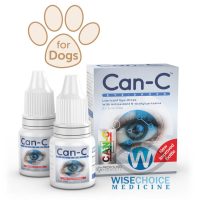
Prefer the original? Can-C Cataract Eye Drops for Dogs use the long-established 1 percent N-Acetyl-Carnosine formula, the one with the longest track record behind it. Same daily habit, same place in the routine, for owners who would rather stay with the drop they know.
The Short Version
Book the eye exam before you need it. Ask your vet for the Schirmer tear test, tonometry, fluorescein stain, and a dilated fundic examination by name. Twice a year from age 7. Watch for cloudiness and hesitation between visits, and support the lens daily in the meantime.
Your dog will not tell you when her vision starts to go. She will just start doing a little less.
References
- Williams DL, Heath MF, Wallace C. Prevalence of canine cataract: preliminary results of a cross-sectional study. Veterinary Ophthalmology. 2004;7(1):29-35. PMID: 14738504. pubmed.ncbi.nlm.nih.gov/14738504
Across a cross-sectional canine population, 50% of dogs showed some degree of lens opacity by 9.4 years, and every dog over 13.5 years was affected.
-

OcluVet® Eye Drops for Pets w/ Cataracts
Price range: $49.98 through $88.97 — or subscribe to save 10% Select options This product has multiple variants. The options may be chosen on the product page
-

OcluVet® Vision Chews for Pets
Price range: $16.96 through $44.98 — or subscribe to save 10% Select options This product has multiple variants. The options may be chosen on the product page