Your dog squints on the walk, then blinks hard in the bright backyard. Most owners read that as a quirk. It can be the first sign the sun is working against your dog’s eyes.
Yes, summer sun can damage your dog’s eyes, though not the way it damages yours. The most common harms are inflammation, sunburned eyelids, and a painful corneal condition called pannus. Underneath all of them runs one process, oxidative stress, and that is where daily protection makes the biggest difference.
This article covers what the sun actually does to a dog’s eyes, which dogs are most at risk, and how to protect their vision from both the outside and the inside.
Frequently Asked Questions
Can the sun really damage my dog’s eyes?
Yes. Ultraviolet light can inflame and sunburn the tissue around the eyes, worsen a corneal disease called pannus, and over years contribute to oxidative damage in the lens. Dogs with light-colored eyes or thin fur around the eyes are the most vulnerable.
Do dogs need sunglasses?
Most dogs do not need them, but some benefit. Dogs with pannus, light sensitivity, or a lot of high-altitude or on-water exposure can be helped by UV-blocking goggles. Shade and timing walks matter more for the average dog.
Can dogs get cataracts from the sun?
Rarely, and mostly in dogs with heavy UV exposure at altitude or on snow, where actinic cataracts can form. In most dogs, cataracts come from genetics or diabetes. Sun’s larger day-to-day role is feeding the oxidative stress that ages the lens.
What are the signs of sun-related eye trouble?
Squinting in bright light, redness, tearing, pawing or rubbing at the face, cloudiness, or reddened, flaky eyelid skin. Any squinting dog should be seen by a vet promptly, since early problems are the easiest to treat.
How the Sun Harms a Dog’s Eyes
The damage starts with ultraviolet light. UV rays carry enough energy to penetrate eye tissue and set off oxidative stress, a buildup of unstable molecules called free radicals that break down proteins and cells the eye needs to stay healthy. The visible glare that makes your dog squint is a separate, milder problem, but the UV is the part that does lasting harm.
That harm shows up in a few specific ways:
- Pannus (chronic superficial keratitis). An immune-driven disease of the cornea that UV exposure inflames and accelerates. Left unmanaged, the scar tissue can spread across the eye and threaten sight. It needs lifelong management.
- Sunburn around the eyes. Dogs with pink or lightly pigmented eyelids can burn on the thin skin around the eye, leaving it red, irritated, and flaky.
- Squamous cell carcinoma. A surface cancer of the eyelid or eye tissue that repeated UV exposure can trigger over time, most often in light-pigmented dogs.
- Light discomfort. Older dogs with iris atrophy, where the pupil no longer closes fully, let in more light and squint harder on bright days.
Which Dogs Are Most at Risk
Some dogs coast through summer with no trouble. Others need real protection. Your dog is higher-risk if any of these fit:
- Light-colored eyes, or pink or unpigmented skin around the eyes and nose
- Thin, fine, or short fur on the face (Whippets, Boxers, and similar)
- German Shepherds, Border Collies, and Greyhounds, which are predisposed to pannus
- A lot of time at altitude, on the water, or on snow, where UV exposure multiplies
- Seniors, whose natural antioxidant defenses have declined with age
If your dog checks one of these boxes, the protection below is worth building into the daily routine now, before the peak-sun weeks.
Protecting Your Dog From the Outside
The first layer is simple: cut the exposure.
- Time the walks. UV is strongest from 10 a.m. to 4 p.m. Early morning and late afternoon walks give your dog the outdoors with a fraction of the radiation.
- Work the shade. On midday outings, stick to the shady side of the street and add shade in the yard where your dog rests.
- Consider UV goggles for high-exposure dogs. For dogs with pannus, light sensitivity, or heavy on-water or high-altitude time, dog goggles that block UVA and UVB reduce the load directly. Introduce them slowly with treats, and skip them if your dog won’t settle.
These steps handle the acute risks. They do not touch the oxidative stress already building inside the eye, which is the second layer.
Protecting Your Dog From the Inside
Physical shade blocks some UV. It does not neutralize the free radicals that get through, and this is the part almost every sun-protection guide skips.
The lens and retina depend on antioxidants to absorb damaging light and mop up free radicals. Two of the most important, glutathione and lutein, decline or run short in aging dogs, which leaves the eye more exposed to oxidative damage in exactly the years UV has been accumulating. Reinforcing that antioxidant defense is where topical and nutritional support come in.
OcluVet® Cataract Eye Drops deliver antioxidants straight to the lens, where the bloodstream cannot reach. The formula is built on N-Acetyl-Carnosine at 2 percent, the highest available concentration, alongside glutathione, L-carnosine, taurine, and vitamin C. Glutathione is the eye’s own primary antioxidant, and topping it up topically supports the lens against the oxidative stress UV drives.
OcluVet® Vision Chews cover the inside. A daily chew supplies lutein, astaxanthin, krill omega-3s, and glutathione. Lutein concentrates in the retina and absorbs harmful light, and dogs cannot make it on their own. Astaxanthin is one of the most active antioxidants for eye tissue.
Used together, the drops defend the lens from the outside and the chews reinforce the retina and whole eye from the inside, the two routes the eye is actually fed.
A Simple Summer Routine
- Morning, with breakfast: one OcluVet Vision Chew, sized to your dog’s weight. The fat in the meal helps the antioxidants absorb.
- Through the day: walk early or late, favor shade midday, and add UV goggles if your dog is high-risk and tolerates them.
- Morning and night: one OcluVet Cataract Eye Drop in each eye.
It takes about a minute a day, and the earlier in the season you start, the more protection your dog gets through the peak-sun months.
Start Before the Peak-Sun Weeks
Summer eye damage is cumulative and quiet. Your dog will not tell you it is happening, and the easiest time to get ahead of it is before the brightest stretch of the season, not after the squinting starts.
Set up your dog’s summer eye routine with OcluVet Cataract Eye Drops and OcluVet Vision Chews, or call us at 1-800-861-4936 and we’ll help you build the right plan for your dog.
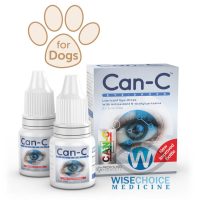
Prefer the original? Can-C Cataract Eye Drops for Dogs are the long-established 1 percent N-Acetyl-Carnosine formula with the longest track record of use, and they are available here too for owners who want the heritage drop.
References
- Williams DL, Munday P. The effect of a topical antioxidant formulation including N-acetyl carnosine on canine cataract: a preliminary study. Veterinary Ophthalmology. 2006;9(5):311-316. PMID: 16939459. pubmed.ncbi.nlm.nih.gov/16939459
In 30 dogs, the OcluVet 2% NAC antioxidant formula reduced lens opacity, reaching statistical significance in early-stage cataract and nuclear sclerosis, with owners reporting improved vision in 80% of cases. - Babizhayev MA, Deyev AI, Yermakova VN, et al. Lipid peroxidation and cataracts: N-acetyl-carnosine as a therapeutic tool to manage age-related cataracts in humans and in canine eyes. Drugs in R&D. 2004;5(3):125-139. PMID: 15139774. pubmed.ncbi.nlm.nih.gov/15139774
Ties oxidative lipid damage to cataract formation and presents N-acetyl-carnosine as a way to counter it in both human and canine eyes. - Wang W, Hernandez J, Moore C, et al. Antioxidant supplementation increases retinal responses and decreases refractive error changes in dogs. Journal of Nutritional Science. 2016;5:e18.
Dogs given a daily carotenoid antioxidant blend, including lutein and astaxanthin, had measurably better retinal function than unsupplemented dogs.
-

OcluVet® Eye Drops for Pets w/ Cataracts
Price range: $49.98 through $88.97 — or subscribe to save 10% Select options This product has multiple variants. The options may be chosen on the product page
-

OcluVet® Vision Chews for Pets
Price range: $16.96 through $44.98 — or subscribe to save 10% Select options This product has multiple variants. The options may be chosen on the product page