Surgery has long been considered the standard way to address cataracts, but for many senior dogs it is not the right choice, and the anesthesia is usually why. Bloodwork has to come back clean first, and cost rules it out for plenty of families.
Antioxidant eye drops put straight in the eye are the main non-surgical option. They work best in the early and intermediate stages, and there is a canine study behind them.
If your dog is 7 or older and you have noticed a haze in the pupil, hesitation at the stairs, or a slower response to a thrown toy, this article covers how to tell cataracts from ordinary aging, what the evidence supports, and the daily routine.
Frequently Asked Questions
Can dogs live with cataracts without surgery?
Yes. Most dogs with cataracts live comfortably without surgery, especially when the clouding comes on slowly and both eyes change at a similar rate. Dogs navigate well on smell and memory. What you do need to watch for is a cataract that has gone dense and started causing trouble: squinting, redness, or your dog rubbing at the eye. That is why a dog managed without surgery still needs regular eye checks with your veterinarian.
Are dogs in pain with cataracts?
A cataract on its own is painless. Pain appears when the lens leaks proteins into the eye and triggers inflammation, or when pressure builds up inside the eye, which is glaucoma. Squinting, redness, a watery eye, or pawing at the face mean something more than the cataract is going on, and your dog needs to see the veterinarian that week.
Should my 12 year old dog have cataract surgery?
That is a conversation with your veterinarian about your individual dog, and for many older dogs the answer is no. Cataract surgery requires general anesthesia, bloodwork that comes back clean, and a referral to a veterinary ophthalmologist. Age alone does not rule a dog out, but kidney, heart and hormonal problems common in older dogs make the anesthesia riskier.
How can I slow down my dog’s cataracts?
Address the oxidative stress driving the damage, from both directions at once. The lens has no blood supply, so nothing your dog eats ever reaches it. A drop in the eye is the only way to get antioxidants to where the cataract is forming. Oral antioxidants support the retina and the eye’s own defenses through the bloodstream. Starting early matters more than anything else you do, because early lenses respond best.
Are there eye drops to dissolve cataracts in dogs?
No drop dissolves a dense mature cataract. N-Acetyl-Carnosine eye drops are the option with published canine evidence: in a University of Cambridge study of the 2% formula, 82% of treated eyes had less cloudy lenses, with the strongest effect on cataracts caught early. Lanosterol drops are the other product you will see advertised.
How can I help my senior dog with cataracts?
Two things at once. Make the house easier for her: keep the furniture where it is, put a night light in the hallway, and speak before you touch her so she is not startled. Then address the oxidative stress behind the clouding, with a drop in the eye for the lens and oral antioxidants for the retina. Have your vet confirm it is a cataract and not nuclear sclerosis before you start anything.
First, Make Sure It Is a Cataract
Two things make a senior dog’s eyes look cloudy. Only one of them damages her sight.
Nuclear sclerosis, also called lenticular sclerosis, is normal aging. The lens keeps making new fibers its whole life and never sheds the old ones, so the center packs tighter and turns a hazy blue-grey. Your dog can still see. Most dogs over 8 have some of it.
A cataract is a cloudy patch inside the lens, made of damaged proteins that have clumped together. Light bounces off the clumps instead of passing through, and your dog sees less as the cloudy patch spreads.
From arm’s length the two look alike. Only your vet can tell them apart, and it takes drops to widen the pupil first. Get that done before you spend money on drops or supplements. Our guide to senior dog eye exams covers the tests to ask for by name.
What Cataracts Do Inside the Lens
In a healthy lens the proteins sit in neat rows and light passes straight through. Oxidative stress is what breaks up those rows. Unstable molecules called free radicals damage the proteins and the fatty membranes around them. The damaged proteins clump together, and the clumps block the light instead of letting it through.
A few things work against a senior dog’s eyes at once:
- Age. The body’s own antioxidant production falls, and glutathione levels in the lens drop with it.
- Genetics. Some breeds are more prone to cataracts, though any dog can develop them with age.
- Diabetes. Extra sugar in the lens turns into a substance called sorbitol, which pulls in water until the lens fibers swell and split. Most diabetic dogs develop cataracts within a year or two of diagnosis, and they come on fast.
- UV exposure. Ultraviolet light accelerates oxidation in the lens, which is why summer sun matters for dogs’ eyes.
- Inflammation and injury. Chronic irritation, trauma or untreated infection can start a cataract independent of age.
Oxidative damage runs through all of them, which is why the non-surgical options target it.
When Surgery Is Not the Right Choice for a Senior Dog
Kidney, cardiac and hormonal conditions are common in senior dogs, and all of them make anesthesia riskier. Age alone does not rule a dog out. Age plus an existing condition often does. That is a conversation to have with your veterinarian.
There is also the recovery. Cataract surgery means a referral to a veterinary ophthalmologist, repeat follow-up visits, and weeks in a plastic collar. If you have had a dog in one you know what that is like: she cannot scratch, she catches it on every doorframe, and nobody in the house sleeps well.
The surgery itself works. A veterinary ophthalmologist removes the clouded lens by phacoemulsification, breaking it up with ultrasound and drawing it out, then places an artificial lens. Vision in a suitable candidate is often very good.
It carries its own complication rate even in people. Babizhayev and colleagues found that in 30% to 50% of human patients the membrane behind the new lens clouds over within two years, with smaller numbers getting a detached retina or corneal problems. Reported rates in dogs run higher still. If surgery is right for your dog, that risk is worth accepting. It is still worth knowing while you are deciding.
If your veterinarian has recommended a surgical evaluation, go and have it. If surgery is not right for your dog, here is what else you can do.
Can Anything Slow Cataracts in Dogs?
Yes, in the early and intermediate stages, and there is canine evidence on both halves of the approach.
A study of the OcluVet® formulation published in Veterinary Ophthalmology by Williams and Munday at the University of Cambridge treated dogs with 2% N-Acetyl-Carnosine drops three times daily. 82% of treated eyes had measurably less cloudiness in the lens and 78% of owners reported their dogs seeing better. The effect was strongest in immature cataracts and nuclear sclerosis. Mature, dense cataracts responded least.
On the oral side, researchers at Seoul National University went back through the records of 172 dogs in 2022. Dogs taking antioxidant supplements held their cataracts back longer once the clouding had taken hold. At the very first stage, when there is only a small spot of cloudiness, the supplements made no measurable difference.
Most of what you find online says nothing slows a cataract and surgery is the only option. In the comments people put it more bluntly: those drops are a scam.
No drop clears a dense mature cataract. Any product that claims otherwise is overselling. The window is early and intermediate, so the sooner you start, the more there is to work with.
Concentration and formulation matter, and here is why. N-Acetyl-Carnosine is a prodrug, which means it only turns into its working form after it has reached the inside of the eye. It passes through the clear front of the eye without breaking down. It survives carnosinase, the enzyme that would otherwise destroy it. And it releases L-Carnosine into the fluid around the lens, where it builds up in the lens itself and keeps working. Plain L-Carnosine dropped in the eye as a 1% solution never builds up at all and washes out in about 30 minutes, so it never gets the chance to protect anything. Two drops can list similar-sounding ingredients and do completely different things for your dog.
Lanosterol drops are the other product you will see advertised. Their canine evidence is thinner, and follow-up work has not reproduced the early results.
How OcluVet® Reaches the Lens From the Outside
The lens has no blood supply. Nothing your dog eats reaches it directly. Antioxidants only get there through the fluid at the front of the eye, which means a drop in the eye is the only way to deliver them.
OcluVet® Cataract Eye Drops carry N-Acetyl-Carnosine at 2%, double the concentration of the 1% human formula. Three ingredients do the work:
- N-Acetyl-Carnosine (2%) delivers L-Carnosine into the fluid around the lens, where it stays long enough to matter
- L-Glutathione is the eye’s primary natural antioxidant, and it is depleted in aging and diabetic eyes
- L-Carnosine keeps sugar from sticking to the proteins in the lens, which is the damage that makes cataracts move so fast in diabetic dogs
L-Cysteine, ascorbic acid, taurine and riboflavin round out the formula, supporting the eye’s own glutathione production and lens cell metabolism. OcluVet® is preservative-free, made in the US, and patented.
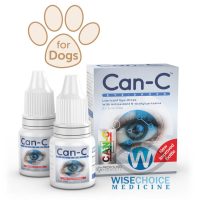
Prefer the original? Can-C™ Cataract Eye Drops for Dogs are the long-established 1% N-Acetyl-Carnosine formula with the longest track record of use, and they are available here for owners who want the heritage drop.
What the Vision Chews Do From the Inside
The retina at the back of the eye is fed by the bloodstream, so the antioxidants that protect it do come from food. OcluVet® Vision Chews cover that half:
- Lutein concentrates in the retina and absorbs blue light. Dogs cannot make it and depend on diet.
- Astaxanthin is among the most active antioxidants for the eye.
- Antarctic krill supplies omega-3 fatty acids that support retinal health and natural eye hydration.
Beta carotene and glutathione support the eye’s own antioxidant defenses alongside them. A 2016 study in the Journal of Nutritional Science found dogs given a daily blend of this class of antioxidants had measurably better retinal function than dogs without it. The chews are flavored with natural chicken liver, contain no preservatives, and most dogs take them as a treat.
The Daily Routine
About a minute a day, total.
- Morning, with breakfast: one Vision Chew, sized by the weight chart on the product page. Fat in the meal helps absorption.
- Three times daily for the first 6 to 8 weeks: one OcluVet drop in each eye. Wipe away discharge, steady your dog, lift the upper lid, apply, let her blink it in.
- After 6 to 8 weeks: one drop in each eye twice daily to maintain.
Most dogs stop objecting within 2 to 3 weeks. Give it 2 to 3 months of consistent dosing before you judge it, and watch how she does: on the stairs, going after a thrown toy, moving around a dim room.
Keep the veterinary checks going either way. A cataract managed without surgery still needs monitoring for inflammation inside the eye, glaucoma, and lens luxation, where the lens slips out of position. Those are the ones that cause real pain.
Start Sooner Rather Than Later
Start early. Drops work best while the cataract is still early. A dense, fully clouded lens barely responds, and a cataract never clears up on its own.
If your dog is 7 or older and you are seeing haze or hesitation, book the exam, find out whether it is a cataract or ordinary aging, and start while the lens can still respond.
Order OcluVet® Cataract Eye Drops and OcluVet® Vision Chews together, and start while the lens can still respond.
References
- Williams DL, Munday P. The effect of a topical antioxidant formulation including N-acetyl carnosine on canine cataract: a preliminary study. Veterinary Ophthalmology. 2006;9(5):311-316. PMID: 16939459. pubmed.ncbi.nlm.nih.gov/16939459
University of Cambridge study of the 2% N-acetyl carnosine formulation in dogs: 82% of treated eyes showed decreased lens opacity and 78% of owners reported improved vision, with the strongest effect in immature cataracts and nuclear sclerosis. - Babizhayev MA, Deyev AI, Yermakova VN, Brikman IV, Bours J. Lipid peroxidation and cataracts: N-acetylcarnosine as a therapeutic tool to manage age-related cataracts in human and in canine eyes. Drugs R&D. 2004;5(3):125-139. PMID: 15139774. pubmed.ncbi.nlm.nih.gov/15139774
Identifies lipid peroxidation as a causative factor in cataract formation, reports the complication rates of cataract surgery, and concludes N-acetylcarnosine is effective for age-related cataract reversal and prevention in both human and canine eyes. - Babizhayev MA. Potentiation of intraocular absorption and drug metabolism of N-acetylcarnosine lubricant eye drops. Drug Metabolism and Drug Interactions. 2009;24(2-4):275-323. PMID: 20408504. pubmed.ncbi.nlm.nih.gov/20408504
Explains why the prodrug form matters: N-acetylcarnosine delivers L-carnosine into the aqueous humor where it accumulates in lens tissue, while plain instilled L-carnosine clears within 30 minutes without accumulating. - Park S, Kang S, Yoo S, Park Y, Seo K. Effect of oral antioxidants on the progression of canine senile cataracts: a retrospective study. Journal of Veterinary Science. 2022;23(3):e43. PMID: 35466599. pubmed.ncbi.nlm.nih.gov/35466599
Retrospective study of 172 dogs aged 8 and over: oral antioxidant supplementation significantly delayed the progression of immature cataracts, with no significant effect at the earliest incipient stage. - Wang W, Hernandez J, Moore C, Jackson J, Narfström K. Antioxidant supplementation increases retinal responses and decreases refractive error changes in dogs. Journal of Nutritional Science. 2016;5:e18. pmc.ncbi.nlm.nih.gov/articles/PMC4891559
Dogs given a daily carotenoid antioxidant blend showed measurably better retinal function than unsupplemented controls, supporting the systemic half of the approach.
-

OcluVet® Eye Drops for Pets w/ Cataracts
Price range: $49.98 through $88.97 — or subscribe to save 10% Select options This product has multiple variants. The options may be chosen on the product page
-

OcluVet® Vision Chews for Pets
Price range: $16.96 through $44.98 — or subscribe to save 10% Select options This product has multiple variants. The options may be chosen on the product page